> For the complete documentation index, see [llms.txt](https://docs.console.zenlayer.com/welcome/llms.txt). Markdown versions of documentation pages are available by appending `.md` to page URLs; this page is available as [Markdown](https://docs.console.zenlayer.com/welcome/elastic-compute/get-started/manage-networking/create-a-public-nat-gateway/configure-snat-rules.md).
# Configure SNAT Rules
Configure SNAT (Source Network Address Translation) rules on a public NAT gateway to let instances without public IPs in a global VPC access the Internet.
## Procedures
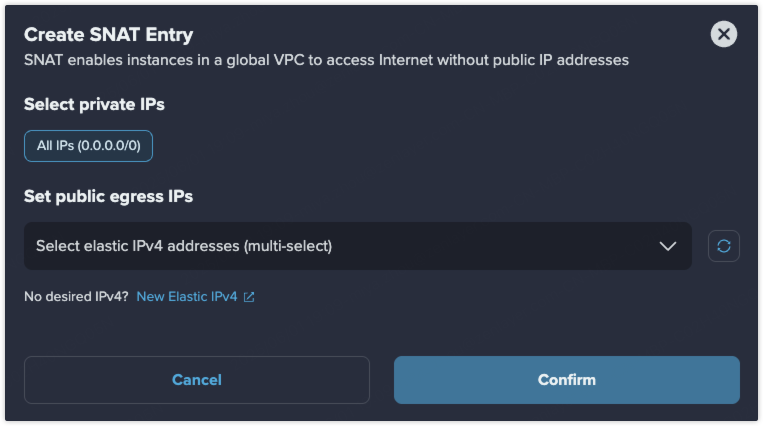
1. Go to **NAT Rules** > **Create SNAT Entry** on details page
2. Select private IPs.
By default, `All IPs (0.0.0.0/0)` is selected, meaning all instances in the subnet can use this SNAT entry.
3. Set public egress IPs
Select one or more elastic IPv4 addresses to serve as the outbound IP(s) for SNAT.
* This determines the source IP address shown to the public internet.
* You can select multiple IPs to support higher availability or bandwidth.
* If no suitable elastic IP is available, click **New Elastic IPv4** to create one.
4. Click **Confirm** to save and apply the SNAT entry.
{% hint style="info" %} **Note**
* A public NAT gateway must be associated with at least one elastic IP before SNAT rules can take effect.
* Each SNAT entry must define a private IP range and at least one public elastic IP.
{% endhint %}
## Results
In the SNAT rule list page, you can edit and delete existing SNAT entries.
If you need further access control of the traffic, see [Configure DNAT Rules](/welcome/elastic-compute/get-started/manage-networking/create-a-public-nat-gateway/configure-dnat-rules.md) for more details.
{% hint style="info" %} **Note**
* Editing NAT rules may cause service disruption. Proceed with caution.
* Deleting resources may affect ongoing services. The related resources will be unbound. Proceed with caution.
{% endhint %}