> For the complete documentation index, see [llms.txt](https://docs.console.zenlayer.com/welcome/llms.txt). Markdown versions of documentation pages are available by appending `.md` to page URLs; this page is available as [Markdown](https://docs.console.zenlayer.com/welcome/cloud-networking/get-started/change-bandwidth.md).
# Change Bandwidth
After creating a Layer 2 or Layer 3 connection, you can modify the bandwidth.
* For Layer 2 connection, go to **Actions** > **Change Bandwidth Cap**.
* For Layer 3 connection, expand the Cloud Router name, and click the access point that you want to operate. **Change Access Bandwidth** in **Information** tab.
When the public cloud is accessed, the bandwidth adjustment will need further attention.
{% hint style="info" %} **Note**
You can view the following contents to know about the cloud connect bandwidth.
* [Configure Bandwidth Cap](/welcome/cloud-networking/get-started/create-a-layer-2-connection.md)
* [Configure Access Bandwidth](/welcome/cloud-networking/get-started/create-a-layer-3-connection/configure-network-information.md)
* AWS cloud connect bandwidth cap range:\ 50 Mbps, 100 Mbps, 200 Mbps, 300 Mbps, 400 Mbps, 500 Mbps, 1 Gbps, 2 Gbps, 5 Gbps, and 10 Gbps.
* Alibaba Cloud cloud connect bandwidth cap range: \ 50 Mbps, 100 Mbps, 200 Mbps, 300 Mbps, 400 Mbps, 500 Mbps, 1 Gbps, 2 Gbps, 5 Gbps, 8 Gbps and 10 Gbps.
{% endhint %}
If you change the bandwidth of a connection with AWS accessed, you can only adjust in a specified range based on the AWS cloud connect bandwidth cap range.
If you change the bandwidth of a connection with Alibaba Cloud accessed, you need to accept the connection again on public cloud if you change over its bandwidth cap range.
### Example 1
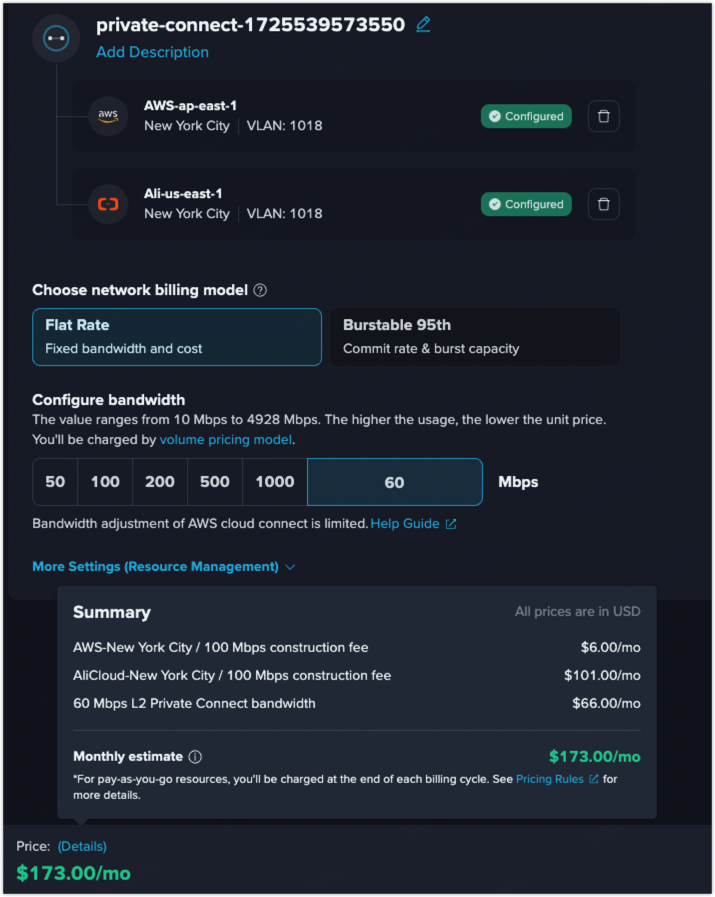
Assume you have configured the bandwidth of your Layer 2 connection as `60 Mbps`. You'll be charged:
* `100 Mbps` AWS cloud connect fee
* `100 Mbps` Alibaba cloud connect fee
* `60 Mbps` L2 Private Connect bandwidth fee
As the AWS cloud connect bandwidth is set as `100 Mbps` and cannot be changed over the bandwidth cap range, you can only change the L2 Private Connect bandwidth between `51 Mbps` and `100 Mbps`. Assume you change the bandwidth to `80 Mbps`. You'll be charged:
* `100 Mbps` AWS cloud connect fee
* `100 Mbps` Alibaba cloud connect fee
* `80 Mbps` L2 Private Connect bandwidth fee
Because `80 Mbps` is still within the previous bandwidth cap range (`50 Mbps` - `100 Mbps`) of Alibaba Cloud, you do not need to re-accept connection on Alibaba Cloud.
### Example 2
Assume a Layer 3 connection with Alibaba Cloud as one access point. You have configured the access bandwidth of Alibaba Cloud as `60 Mbps`.
As the Alibaba cloud connect bandwidth falls in `50 Mbps` - `100 Mbps` bandwidth cap range,
* if you change bandwidth with this bandwidth cap range, such as `80 Mbps`, you do not need to re-accept connection on Alibaba Cloud;
* if you change bandwidth down or over this bandwidth cap range, such as `40 Mbps` or `180 Mbps`, you need to re-accept connection on Alibaba Cloud. See [Alibaba Cloud Configuration](/welcome/cloud-networking/get-started/validate-connection-in-public-cloud/alibaba-cloud-configuration.md) for more details.