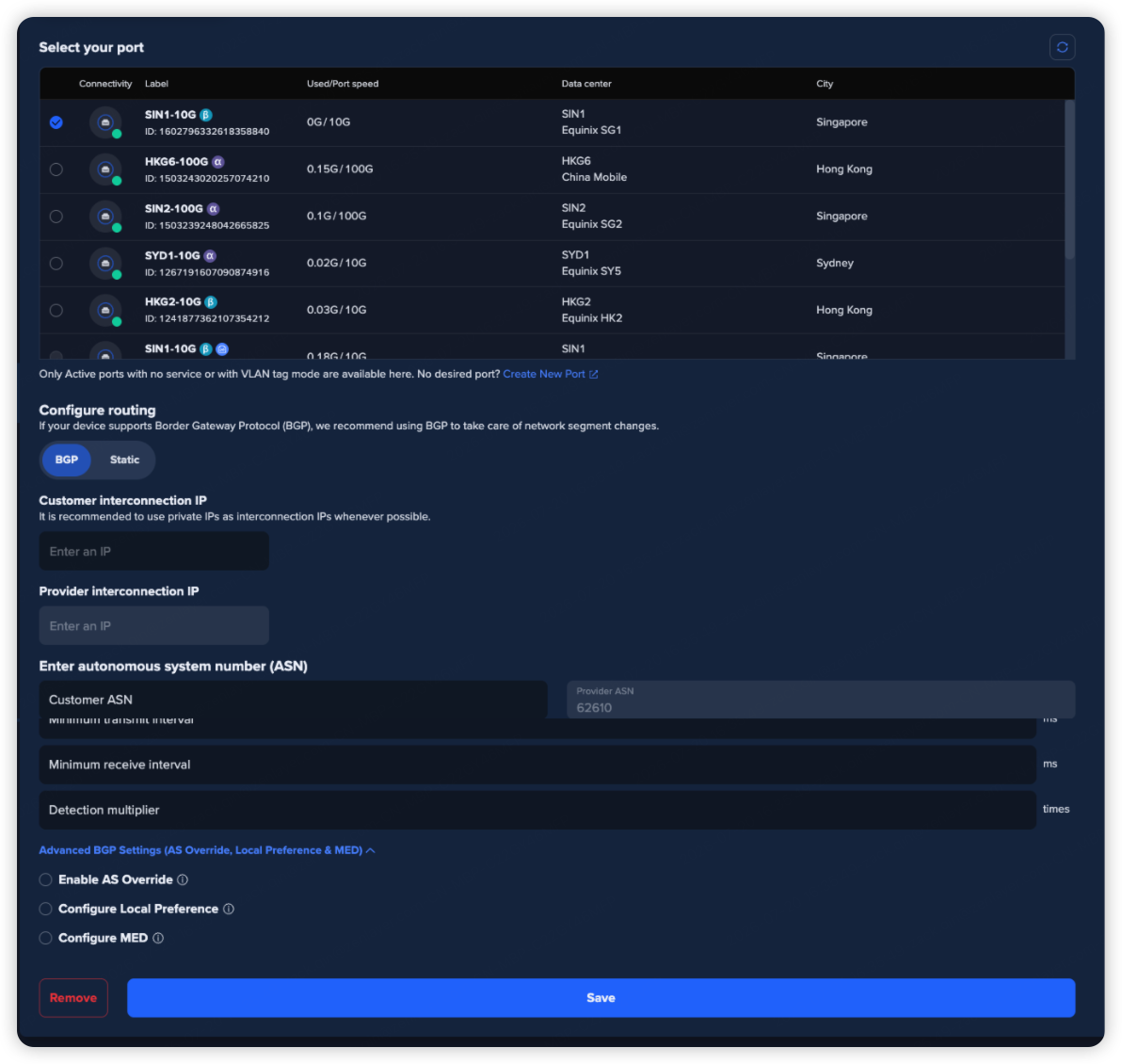
Data Center Connection
Data Center Connection
 **Note**\ To future-proof your business, a 10 Gbps above port rate is recommended.
3. Label your port for identification.
4. Enter the legal business name of the authorized party. You will receive an LOA (letter of authorization) that is used to establish your cross connect.
**Note**
* The LOA will be emailed to you as an attachment 2 to 3 days after you submit your new port order. You can also download your LOA in the **Port** on zenConsole.
* The LOA will expire in 30 days. Please establish your cross connect as soon as possible.
## Configure Routing
If your device supports Border Gateway Protocol (BGP), we recommend using **BGP** to take care of network segment changes automatically. You can also choose **Static** routing.
Configure the following routing information:
* **Customer interconnection IP**: The interconnection IP address on your side. It is recommended to use private IPs whenever possible. The customer and provider interconnection IPs should be in the same subnet, typically with a /30 mask.\
For example: `192.168.100.1/30`.
* **Provider interconnection IP**: The interconnection IP address on the Zenlayer side.\
For example: `192.168.100.2/30`.
* **Autonomous system number (ASN)**:
* **Customer ASN**: Your ASN. A private ASN is recommended (16-bit: 64512–65534; 32-bit: 4200000000–4294967294).\
For example: `65001`.
* **Provider ASN**: The Zenlayer ASN. It defaults to `62610` and cannot be changed.
* **BGP MD5 (optional)**: The BGP authentication (message-digest algorithm 5) key. Leave it empty to disable authentication.\
For example: `Zenlayer@2026`.
For more details about routing protocols, see [**Configure Routing**](/welcome/cloud-networking/get-started/create-a-layer-3-connection/configure-routing-information.md).
### Enable BFD
Enable Bidirectional Forwarding Detection (BFD) to quickly detect link failures and trigger failover. Once enabled, configure the following:
* **Minimum transmit interval**: In milliseconds (ms). Recommended value: `300`.
* **Minimum receive interval**: In milliseconds (ms). Recommended value: `300`.
* **Detection multiplier**: In times. Recommended value: `3` (the link is considered down after 3 consecutive detection cycles receive no packet).
### Advanced BGP Settings
Expand **Advanced BGP Settings (AS Override, Local Preference & MED)** to further optimize your routing policy:
* **Enable AS Override**: When multiple access points in your Layer 3 network use the same ASN, override the duplicate AS number in the AS path to prevent routes from being dropped by loop detection.\
Recommendation: enable only when multiple access points share the same ASN; otherwise keep it off.
* **Configure Local Preference**: Set the local preference to control outbound traffic path selection. A higher value has higher priority.\
For example: `100` (default); set a higher value such as `200` to prefer a specific link.
* **Configure MED**: Set the Multi-Exit Discriminator (MED) to influence inbound traffic path selection. A lower value has higher priority.\
For example: `0` (default); set a lower value to prefer a specific link.
Once configured, click **Save** to save the configuration of this access point.
**Note**\ To future-proof your business, a 10 Gbps above port rate is recommended.
3. Label your port for identification.
4. Enter the legal business name of the authorized party. You will receive an LOA (letter of authorization) that is used to establish your cross connect.
**Note**
* The LOA will be emailed to you as an attachment 2 to 3 days after you submit your new port order. You can also download your LOA in the **Port** on zenConsole.
* The LOA will expire in 30 days. Please establish your cross connect as soon as possible.
## Configure Routing
If your device supports Border Gateway Protocol (BGP), we recommend using **BGP** to take care of network segment changes automatically. You can also choose **Static** routing.
Configure the following routing information:
* **Customer interconnection IP**: The interconnection IP address on your side. It is recommended to use private IPs whenever possible. The customer and provider interconnection IPs should be in the same subnet, typically with a /30 mask.\
For example: `192.168.100.1/30`.
* **Provider interconnection IP**: The interconnection IP address on the Zenlayer side.\
For example: `192.168.100.2/30`.
* **Autonomous system number (ASN)**:
* **Customer ASN**: Your ASN. A private ASN is recommended (16-bit: 64512–65534; 32-bit: 4200000000–4294967294).\
For example: `65001`.
* **Provider ASN**: The Zenlayer ASN. It defaults to `62610` and cannot be changed.
* **BGP MD5 (optional)**: The BGP authentication (message-digest algorithm 5) key. Leave it empty to disable authentication.\
For example: `Zenlayer@2026`.
For more details about routing protocols, see [**Configure Routing**](/welcome/cloud-networking/get-started/create-a-layer-3-connection/configure-routing-information.md).
### Enable BFD
Enable Bidirectional Forwarding Detection (BFD) to quickly detect link failures and trigger failover. Once enabled, configure the following:
* **Minimum transmit interval**: In milliseconds (ms). Recommended value: `300`.
* **Minimum receive interval**: In milliseconds (ms). Recommended value: `300`.
* **Detection multiplier**: In times. Recommended value: `3` (the link is considered down after 3 consecutive detection cycles receive no packet).
### Advanced BGP Settings
Expand **Advanced BGP Settings (AS Override, Local Preference & MED)** to further optimize your routing policy:
* **Enable AS Override**: When multiple access points in your Layer 3 network use the same ASN, override the duplicate AS number in the AS path to prevent routes from being dropped by loop detection.\
Recommendation: enable only when multiple access points share the same ASN; otherwise keep it off.
* **Configure Local Preference**: Set the local preference to control outbound traffic path selection. A higher value has higher priority.\
For example: `100` (default); set a higher value such as `200` to prefer a specific link.
* **Configure MED**: Set the Multi-Exit Discriminator (MED) to influence inbound traffic path selection. A lower value has higher priority.\
For example: `0` (default); set a lower value to prefer a specific link.
Once configured, click **Save** to save the configuration of this access point.