Create a Layer 2 Private Connect
Create a Layer 2 Private Connect
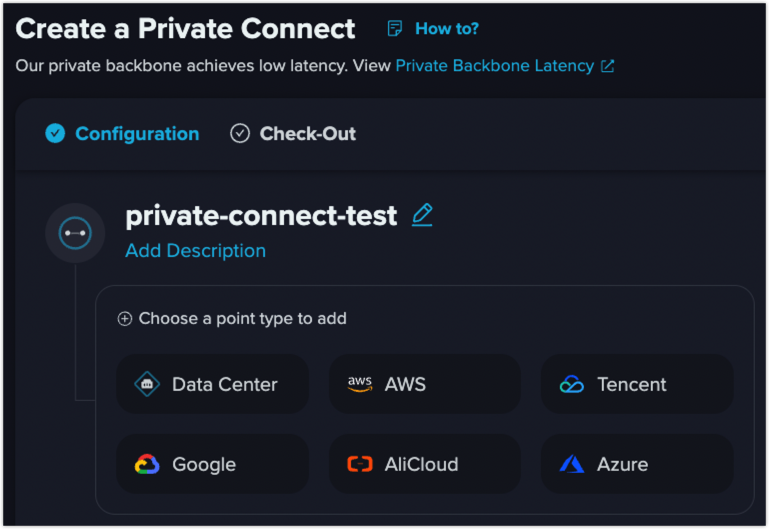
 to modify the label name of your private connect. You can also click **Add Description** to give the private connect a note.
### 2. Add Access Points
Select two access points as the source end and the destination end of your private connect.\
You may have the following options:
* [**Data Center**](/welcome/cloud-networking/get-started/create-a-layer-2-connection/select-a-data-center-as-access-point.md)
* [**Public Cloud**](/welcome/cloud-networking/get-started/create-a-layer-2-connection/select-a-public-cloud-as-access-point.md)
{% hint style="info" %} **Note**
* A Layer 2 private connect cannot connect Tencent Cloud and Google Cloud to each other.
* For Alibaba Cloud and BytePlus, the two access points of a private connect cannot both be the same cloud.
{% endhint %}
### 3. Configure Bandwidth Cap
[**Configure the bandwidth cap**](/welcome/cloud-networking/get-started/create-a-layer-2-connection/configure-network-information.md) between two access points of your Layer 2 private connect.
### 4. Confirm Order and Pay for It
## What to Do Next
More operations offline or on the public cloud console.
### For the Public Cloud Point
[**Validate your cloud connect**](/welcome/cloud-networking/get-started/validate-connection-in-public-cloud.md) on the corresponding console of your public cloud provider.
### For the Data Center Point
Contact Zenlayer Support or your data center operator to establish a cross connect offline.
## Result
After your cross connect is established offline and your cloud connect is validated on the public cloud console, the states of corresponding points will change into **Active** and you will receive a notification email.
Once the states of both ends are **Active**, your private connect state will become **Active**.
{% hint style="info" %} **Note**
* Billing for private connect starts as soon as the private connect is provisioned successfully. It does not wait for the source and destination end points to become active.
* Billing for your port will start:
* when the port is active.
* 15 days after you submit the order – whether or not your cross connect has been established.
* Billing for your cloud connect will start:\ Once you have validated your cloud connect on the public cloud console.
{% endhint %}
---
# Agent Instructions
This documentation is published with GitBook. GitBook is the documentation platform designed so that both humans and AI agents can read, navigate, and reason over technical content effectively. Learn more at gitbook.com.
## Querying This Documentation
If you need additional information that is not directly available in this page, you can query the documentation by asking a question.
Perform an HTTP GET request on the following URL with the `ask` and `goal` query parameters:
```
GET https://docs.console.zenlayer.com/welcome/cloud-networking/get-started/create-a-layer-2-connection.md?ask=
to modify the label name of your private connect. You can also click **Add Description** to give the private connect a note.
### 2. Add Access Points
Select two access points as the source end and the destination end of your private connect.\
You may have the following options:
* [**Data Center**](/welcome/cloud-networking/get-started/create-a-layer-2-connection/select-a-data-center-as-access-point.md)
* [**Public Cloud**](/welcome/cloud-networking/get-started/create-a-layer-2-connection/select-a-public-cloud-as-access-point.md)
{% hint style="info" %} **Note**
* A Layer 2 private connect cannot connect Tencent Cloud and Google Cloud to each other.
* For Alibaba Cloud and BytePlus, the two access points of a private connect cannot both be the same cloud.
{% endhint %}
### 3. Configure Bandwidth Cap
[**Configure the bandwidth cap**](/welcome/cloud-networking/get-started/create-a-layer-2-connection/configure-network-information.md) between two access points of your Layer 2 private connect.
### 4. Confirm Order and Pay for It
## What to Do Next
More operations offline or on the public cloud console.
### For the Public Cloud Point
[**Validate your cloud connect**](/welcome/cloud-networking/get-started/validate-connection-in-public-cloud.md) on the corresponding console of your public cloud provider.
### For the Data Center Point
Contact Zenlayer Support or your data center operator to establish a cross connect offline.
## Result
After your cross connect is established offline and your cloud connect is validated on the public cloud console, the states of corresponding points will change into **Active** and you will receive a notification email.
Once the states of both ends are **Active**, your private connect state will become **Active**.
{% hint style="info" %} **Note**
* Billing for private connect starts as soon as the private connect is provisioned successfully. It does not wait for the source and destination end points to become active.
* Billing for your port will start:
* when the port is active.
* 15 days after you submit the order – whether or not your cross connect has been established.
* Billing for your cloud connect will start:\ Once you have validated your cloud connect on the public cloud console.
{% endhint %}
---
# Agent Instructions
This documentation is published with GitBook. GitBook is the documentation platform designed so that both humans and AI agents can read, navigate, and reason over technical content effectively. Learn more at gitbook.com.
## Querying This Documentation
If you need additional information that is not directly available in this page, you can query the documentation by asking a question.
Perform an HTTP GET request on the following URL with the `ask` and `goal` query parameters:
```
GET https://docs.console.zenlayer.com/welcome/cloud-networking/get-started/create-a-layer-2-connection.md?ask=