> For the complete documentation index, see [llms.txt](https://docs.console.zenlayer.com/welcome/llms.txt). Markdown versions of documentation pages are available by appending `.md` to page URLs; this page is available as [Markdown](https://docs.console.zenlayer.com/welcome/content-delivery-network/domain-management/advanced-settings.md).

# Advanced Settings

Click one domain name in the domain list and click **Advanced**.

This contains CDN advanced settings, mainly to improve performances and user experiences.

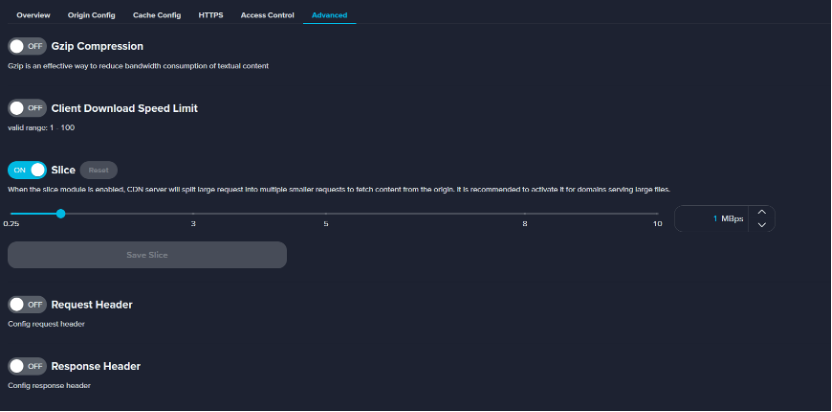
<div align="left"><figure><img src="/files/BtckVOmHCg3dKG5vTJ24" alt=""><figcaption></figcaption></figure></div>

<table><thead><tr><th width="153">Parameter</th><th>Description</th></tr></thead><tbody><tr><td>Gzip Compression</td><td><p>After you enable the Gzip compression feature, Zenlayer CDN points of presence (POPs) use the Gzip compression to compress resources before the resources are returned to clients.</p><p>The Gzip compression feature reduces file sizes, accelerates file distribution, and reduces bandwidth consumption.</p></td></tr><tr><td>Client Download Speed Limit</td><td><p>Enable the download speed limit to limit the bandwidth of each client.</p><p>It is recommended to enable it in the large file download scenario, which can effectively reduce the overall burst bandwidth.</p></td></tr><tr><td>Slice</td><td><p>When the slice module is enabled, CDN server will split large request into multiple smaller requests to fetch content from the origin.</p><p>It is recommended to activate it for domains serving large files.</p></td></tr><tr><td>Request Header</td><td>This configuration will modify the request header information displayed when the CDN returns to the origin site, which can be used as a security check for the origin site.</td></tr><tr><td>Response Header</td><td>This configuration will modify the response header information returned by the CDN to the client for security detection of the client.</td></tr></tbody></table>


---

# Agent Instructions
This documentation is published with GitBook. GitBook is the documentation platform designed so that both humans and AI agents can read, navigate, and reason over technical content effectively. Learn more at gitbook.com.

## Querying This Documentation
If you need additional information that is not directly available in this page, you can query the documentation dynamically by asking a question.

Perform an HTTP GET request on the current page URL with the `ask` query parameter, and the optional `goal` query parameter:

```
GET https://docs.console.zenlayer.com/welcome/content-delivery-network/domain-management/advanced-settings.md?ask=<question>&goal=<endgoal>
```

`ask` is the immediate question: it should be specific, self-contained, and written in natural language.
`goal` is optional and describes the broader end goal you are ultimately trying to accomplish on behalf of the user. GitBook uses it to tailor the answer towards what is most useful for that goal.

The response will contain a direct answer to the question and relevant excerpts and sources from the documentation.

Use this mechanism when the answer is not explicitly present in the current page, you need clarification or additional context, or you want to retrieve related documentation sections.
